Roulette Rivals events are hosted in three main formats: Double Elimination, Swiss, and RRWC. The Double Elimination format was last used in Roulette Rivals 18. You can read about the Swiss format here, while the RRWC variant of the page will be added in the future.
¶ Overview
Double Elimination (often shortened to Double Elim or DE) is the simplest format used in Roulette Rivals tournaments. At the start of the event, a partially seeded knockout bracket known as the Winners Bracket (WB) is drawn, with seeds assigned to the top 16 players.
After each round in the Winners Bracket, winners advance to the next round. Losers are not eliminated, but instead drop down into the Losers Bracket (LB). After each round in the Losers Bracket, winners continue, while losers are eliminated from the tournament.
The Grand Final is played between the winners of the final match in each bracket (the WB Final and the LB Final). The player coming from the Winners Bracket typically receives a small advantage during the scheduling and drafting process. The winner of the Grand Final, the longest and most prestigious match of the tournament, is crowned Roulette Rivals Champion.
¶ Matches and Scheduling
Every match before the WB and LB Finals is First-to-6, meaning the match ends once one player reaches 6 points.
- Both players ban one map each, then pick one map each.
- Upon scheduling, four additional random maps are revealed.
- Once a player picks or bans a map, that player cannot pick or ban it again until the Grand Final.

The WB Final and LB Final are First-to-8, meaning the match ends once one player reaches 8 points.
- Both players ban one map each, then pick two maps each.
- Upon scheduling, four additional random maps are revealed.
- Once a player picks or bans a map, that player cannot pick or ban it again until the Grand Final.

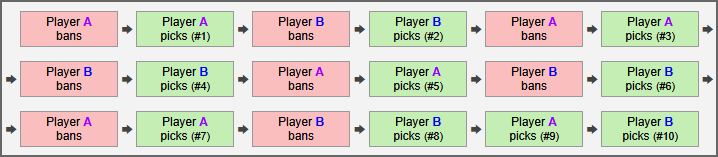
The Grand Final is First-to-10, meaning the match ends once the champion reaches 10 points.
- The final draft follows a fixed order designed to give Player A, the player advancing from the Winners Bracket, a slight advantage.
- The Grand Final features a mappool reset, removing previous restrictions. However, each map can only be selected by one player.
¶ Deadlines and Inactivity
Roulette Rivals tournaments using the Double Elimination format typically last 4.5 weeks. The deadlines for Roulette Rivals 18 are as follows:
- Signups open: Monday, 19 January 2026, 12:00 CET
- Signups close: Thursday, 29 January 2026, 18:00 CET
- Bracket draw: Thursday, 29 January 2026, 21:00 CET
- Start of tournament: Friday, 30 January 2026, 12:00 CET
- Grand Final: Sunday, 1 March 2026
Double Elimination tournaments use several soft deadlines to ensure the bracket progresses smoothly. These per-round deadlines are shared in the #info channel on Discord. In general, players are expected to play one Winners Bracket match every five days, and one Losers Bracket match every two to three days.
Soft deadlines do not have to be met exactly. However, admins may step in if matches fall significantly behind schedule due to lack of availability or repeated no-shows. Players are asked not to fall more than two days behind schedule, and if they do play late, they should aim to catch up as quickly as possible, for example, by prescheduling with potential next-round opponents. If a match delays the bracket too much, admins may issue a forfeit to the player deemed at fault.